
The Reversible Decision: A Product Manager's Guide to Navigating Uncertainty
Certainty is a recipe for brittleness. In fluid markets, the only real strategy is a shock absorber. From Bezos's Two-Way Doors to the Three-Strike Rule, learn how the Reversible Decision framework lowers the cost of being wrong and creates the space for growth.
Most product failures don't start with a bad idea. They start with a good idea that got locked in too early.
Not through negligence or laziness, but through conviction. It stems from the reasonable, well-intentioned belief that committing fully to a direction is what good leadership looks like. The roadmap gets set. The architecture gets built. The pricing gets announced. And then the market responds unpredictably. The team discovers that changing course is simply too expensive.
This fundamental tension (the clash between the "hard" requirements of building and the "fluid" reality of the market) is where most product failures are born. This cycle of premature permanence is easy to walk into, often without realizing it until the door is already shut.

I know because I've been the one holding the key.
Early in my career, I pushed for an architecture that could handle a dozen hypothetical use cases, none of them validated yet. The instinct felt sound: anticipate problems before they happen, build systems that don't require rework, think three steps ahead. By the time the real requirements arrived, the foundation was already cemented. The "future-proof" system I'd lobbied for had become a cage. Changing direction meant ripping out months of work. So we didn't change direction. We rationalized the constraints. We built features around the foundation instead of questioning the foundation itself.
That's the insidious part of over-commitment. The psychological cost far outweighs the financial one. You've invested too much, explained the decision to too many people, built too much on top of it. The sunk cost becomes a narrative. The narrative becomes a strategy. And the strategy marches forward into a market that has already moved on.
I learned this as an engineer building monolithic architectures, but the exact same pathology paralyzes product strategy and go-to-market plans. We confuse committing to a vision with committing to a specific path. We try to future-proof our way out of uncertainty by building complex, rigid solutions for problems we don't yet have, terrified that changing our minds will look like a lack of conviction.
Resisting this pressure requires more than good intentions. It requires a different framework for how decisions get made and what counts as a good one.
Rather than finding the perfect path upfront, your job is to commit to the destination while lowering the cost of changing the path.
Three Ways Rigidity Shows Up
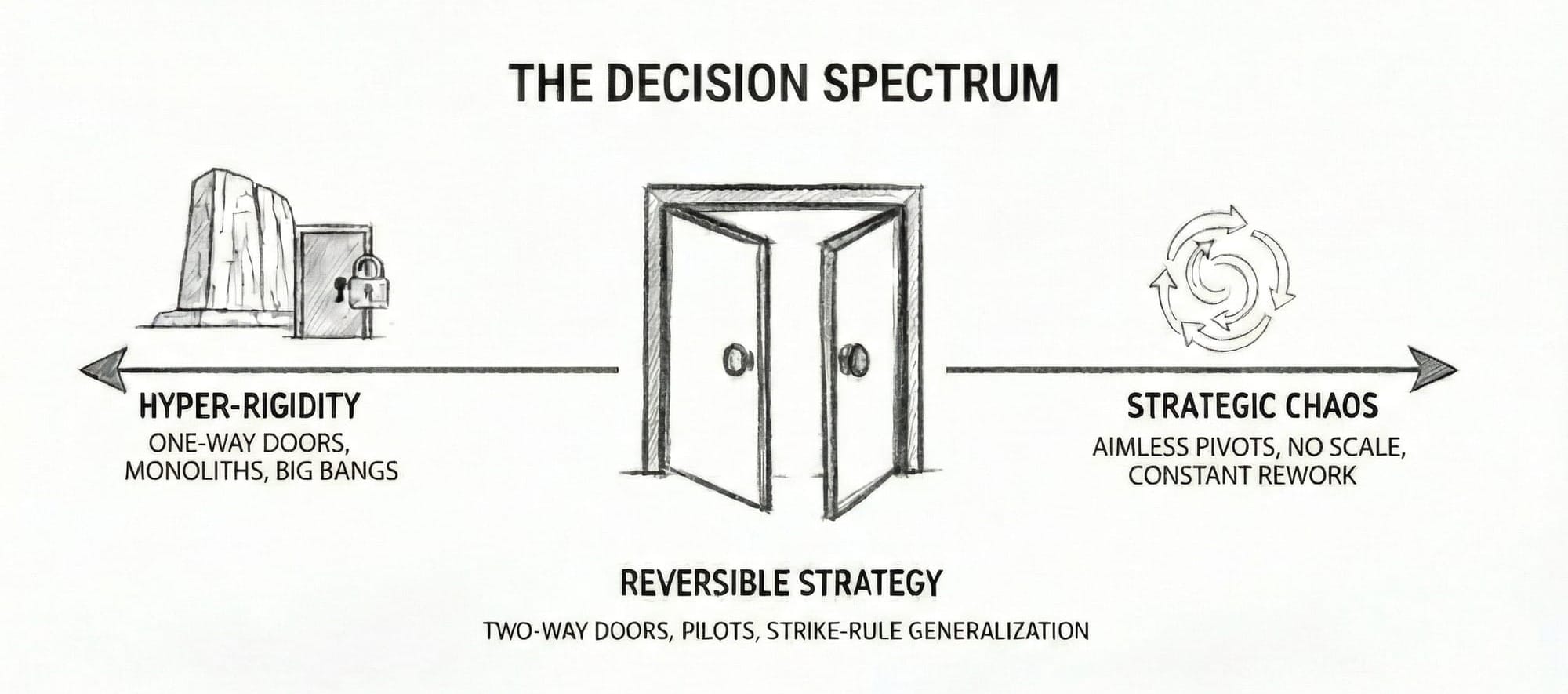
Organizations often feel trapped in a false binary. They either operate in hyper-rigid states (leading to massive, slow-moving failures) or in chaotic, aimless states where they pivot so often they never achieve scale. When they choose rigidity, premature lock-in manifests in different ways depending on the domain. It usually presents as one of three distinct symptoms.
The Engineering Prison
When a team tries to future-proof a system before the market has spoken, the result is usually a monolith, an architecture so thoroughly designed for every possible scenario that it can't change when the actual scenario arrives. Generalization requires pattern recognition. Patterns require data. Data requires shipping something first. You can't generalize from zero. You just end up trading the possibility of future rework for the certainty of current technical debt.
The Expansion Fallacy
The same instinct plays out at the strategic level when a product enters a new market. Rather than a reversible pilot (a single city, a specific niche, a limited SKU) teams go for the Big Bang. Full commitment before validation.Consider Target's entry into Canada. They bought multiple leaseholds from a failing retailer and tried to open over 100 stores nearly simultaneously, committing to a full national infrastructure before validating a single customer preference in a Canadian aisle. By the time they found that their inventory systems were broken and their pricing didn't resonate, the cost of reversal was in the billions. This is the belief that capital can substitute for validation, that if you commit hard enough, the market will meet you there.
The Pricing Lock-in
Pricing changes are the most anxious commitments a PM makes, and the most dangerous to get wrong publicly. Unity's 2023 Runtime Fee debacle is the clearest recent example: they shifted their business model to charge developers per game installation. The change was announced to the entire world at once. There was no "opt-in" beta, no localized testing, and no clear path to walk it back without destroying developer trust.
Instead of a reversible pilot, testing the model with a small cohort or introducing it alongside the old structure, they likely spent months in analysis trying to predict every reaction. They launched a change that gave them no exit when the assumptions proved false. The public retreat cost them their CEO and years of goodwill.
Why We Default to Rigidity
Why do we consistently default to the most complex, irreversible path? If we look under the hood of these failures, we find four systemic forces that make lock-in feel like responsible management.
1. The Predictability Mandate
Rigid plans rarely exist in a vacuum. Product Managers don't create 12-month, inflexible roadmaps because they want to; they do it because Sales needs to hit quotas, Marketing needs to plan campaigns, and the Board demands predictability.
Certainty is the currency of the enterprise. The entire corporate apparatus, annual budgeting, OKRs, performance reviews, is designed to reward predictability and punish changing your mind. The system demands certainty, but the market refuses to provide it.
2. The False Logic of "Doing it Right"
There is a rational, persistent belief that "doing it right the first time" is cheaper. We tell ourselves that if we build the comprehensive platform now, we won't have to rebuild it later. We treat thoroughness as safety, modeling every edge case to avoid reversing course.
But this ignores the literal cost of delay. McKinsey & Co. research found that decision paralysis and slow decision-making cost the average Fortune 500 company $250 million annually in wasted managerial time. When we treat a feature as a permanent commitment, we aren't being "robust"; we are just being expensive. The "right" solution that takes twelve months to build is often "wrong" by the time it ships because the market didn't wait.
Analysis functions as a tax on your ability to learn.
3. The Emotional Weight of Rework
Third, there is a deep, human empathy for the effort of our teams. We want to protect our developers and marketers from the frustration of changing directions. Once a decision is announced, reversing it looks like a failure of leadership.
The organizational reward for decisiveness is immediate. The organizational cost of over-commitment is deferred, sometimes by years.
Because of this deferred cost, we try to prevent the small pain of a two-week pivot. But in doing so, we set our teams up for the catastrophic pain of a two-year failure. True empathy means giving the team a system resilient enough to handle a moving target, rather than locking them into a fixed one.
4. The Illusion of Control
Finally, at the deepest level, over-engineering and "big-bang" strategies are defense mechanisms against a lack of control. If we can't predict the market, we try to build a system that can handle any market.
It is an attempt to eliminate the "fuzziness" of the world through the "hardness" of our plans. We want the market to behave like a compiled language where everything is defined upfront, but it's actually a runtime environment where requirements are injected at the last second.
You cannot solve an external uncertainty problem with internal complexity. You just end up with a complex system that is still fundamentally uncertain, and now also impossible to change.
The PM as a Manager of Reversibility
The most important realization a Product Manager can make is that their primary job is creating systems that thrive in uncertainty, rather than trying to eliminate it.
Think of the relationship between Product and Market like a suspension system. Market needs, stakeholder demands, and user feedback are the uneven road, constantly shifting, throwing up obstacles, and creating sudden shocks. The rest of the organization - Engineering, Sales, Operations, needs a stable enough ride to execute with confidence.
Your job is to design the strategic shock absorber.
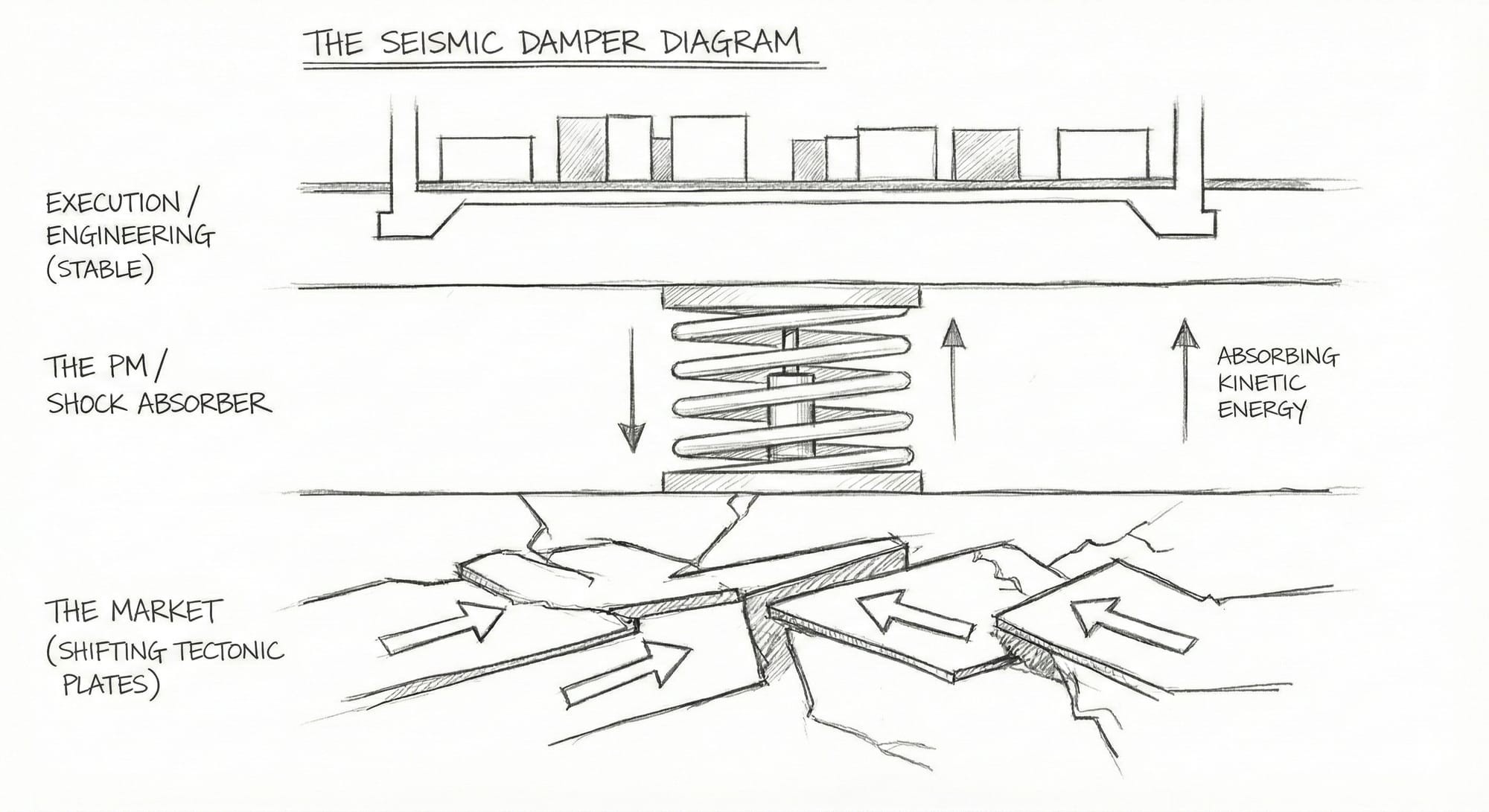
If your suspension is too stiff, if your strategy is too rigid, the organization snaps under the pressure of a pivot. Every minor bump in the market rattles the entire engine, leading to burnout and mechanical failure. If it's too soft, if your strategy is aimless, the organization topples because there's no direction.
A well-tuned strategy absorbs the ambiguity of early market signals so the team can build with clarity today, while keeping the architecture adaptable for tomorrow. You translate the unpredictable input of the road into enough stability for execution, without losing the flexibility to handle the next shift. In fluid markets, your suspension system, not your plan is your true competitive advantage.
A Framework for Reversibility
To be an effective navigator of uncertainty, you need a way to categorize decisions and a disciplined way to stagger your investment.
The Two-Way Door
Jeff Bezos described a simple but consequential way to categorize decisions.
- Type 1 (One-Way Doors): These are consequential and nearly impossible to reverse. Moving your entire data center to a new region or signing a ten-year exclusivity deal. These require slow, heavy-handed analysis and senior-level caution.
- Type 2 (Two-Way Doors): These are reversible. Testing a new feature with 5% of users or launching a pilot in a single city. If you walk through and don't like what you see, you can simply walk back through. These should be made quickly with high velocity.
Most product failures stem from treating Type 2 decisions with Type 1 caution, and the result is an organization that moves too slowly to learn anything. While One-Way Doors are unavoidably permanent, the goal is to rigorously delay them until the data is undeniable, keeping everything else reversible.
The Three-Strike Rule
Generalization is a privilege that must be earned by data. To maintain maximum optionality, don't generalize a solution until you've seen the pattern at least three times.
- Strike 1: Specificity. Solve the specific problem for the user you have today. This is an exercise in humility: building the simplest thing that provides value now without assuming you know the future.
- Strike 2: Pattern-Matching. When you see the problem a second time, solve it again. Look for the commonalities between this instance and the first.
- Strike 3: Investment. Only when you have a third data point do you have a pattern. Now you invest in the platform. Now you generalize.
This keeps your options open at the earliest, most uncertain stage. When you're on Strike 1, you're not building something sloppy; you're building something honest.
Simple vs. Naive
There's a dangerous pitfall in the Strike 1 phase: the difference between a simple solution and a naive one. They look identical from the outside, but the difference is in what they foreclose.
A simple solution handles the current use case without locking you into a dead end. A naive solution solves today's problem by guaranteeing you'll have to solve it again, from scratch, as you grow.
Are you building a strategic experiment, or are you just scheduling rework you're too busy to admit today?
Imagine you need video encoding. If you're validating whether users want encoding at all, a quick custom MP4 converter is a reasonable reversible experiment. But if encoding is already confirmed and the open question is which formats users need, choosing MP4-only is naive. You're not testing a hypothesis; you're scheduling a dead end.
The same applies strategically. If you are launching a new B2B product, manually onboarding the first 10 customers is a simple, reversible experiment to validate demand. Spending three months building an automated self-serve portal before you have a single paying customer is naive scheduling of rework. One is a strategic experiment. The other is a failure disguised as simplicity.
Your Strike 1 choice must be aligned with what you are actually trying to prove. If the foundation itself is the irreversible choice, you haven't avoided rework; you've moved it into the backlog where it will fester.
The Thematic Roadmap
The first three tools tell you how to build the product. But if you walk into a board meeting and tell the VP of Sales that your plans are "reversible," they will likely panic. How do you act as a manager of reversibility in an organization that demands a 12-month feature list?
You change what you promise. Instead of committing to the implementation (a specific feature), you commit to the destination (a solved problem or a specific theme). You give stakeholders certainty on the outcome ("we will solve enterprise SSO in Q3"), but you fiercely defend the reversibility of the path.
If your organization is so rigid that stakeholders refuse a thematic roadmap and demand a list of features, you still have an alternative. Shift the conversation from output to outcomes. Agree on the success metrics first. If you must commit to a feature list, make it clear to senior leadership that the commitment is to moving the metric. If the initial feature fails to move the needle, the team must have the space to reverse the implementation without it being labeled a failure of execution.
Before You Commit
When you start viewing the role through the lens of reversibility, your priorities shift in concrete ways.
You stop asking "what is the right answer?" and start asking "how do we make it easy to change the answer later?" That question removes a surprising amount of ego from the room. The argument is no longer about who has the best prediction. It's about who is designing the most adaptable path forward.
You protect your team's velocity, not just their feelings. Reversible decisions don't just reduce strategic risk. They reduce the kind of accumulated, grinding pressure that comes from knowing a two-year bet is starting to look wrong but feeling unable to say so.
You trade future-proofing for present-solving. You solve the problems that exist today with the data you have today, while keeping your foundations simple rather than naive.
Reversibility is the recognition that the cost of being wrong compounds the later you catch it. Staying flexible to gather real signals is worth more than the elegance of a plan made before the evidence is in.
The goal is to make your organization resilient enough to handle any terrain, rather than trying to pave the road. Before you commit to the "right" answer, ask if you can walk back from it. If you can walk back through the door, you can afford to move much faster.
Diagnostic Questions for Your Next Decision
Before you commit, run through these. They take two minutes and they have a way of surfacing the assumptions you've been quietly avoiding.
- Can you walk it back? If this decision turns out to be wrong, is reversal possible or has the door already locked behind you?
- Is this simple or naive? Does the foundation you're laying allow for growth, or does it foreclose options you haven't needed yet?
- What is the cost of being wrong? If this fails, does it take down the whole company or just a single pilot?
- Are you on Strike 3 before you've seen Strike 1? Are you generalizing for a pattern that hasn't shown up in the data yet?
If the answers point toward lock-in, you're not building a strategy. You're building a rigid system that will eventually snap. Tune your suspension instead.