
The Machinery
Your fitness app warns your streak will break. Your meditation app reminds you to be mindful. None are designed for peace of mind. They're designed to keep the machinery running. What if we built products differently?
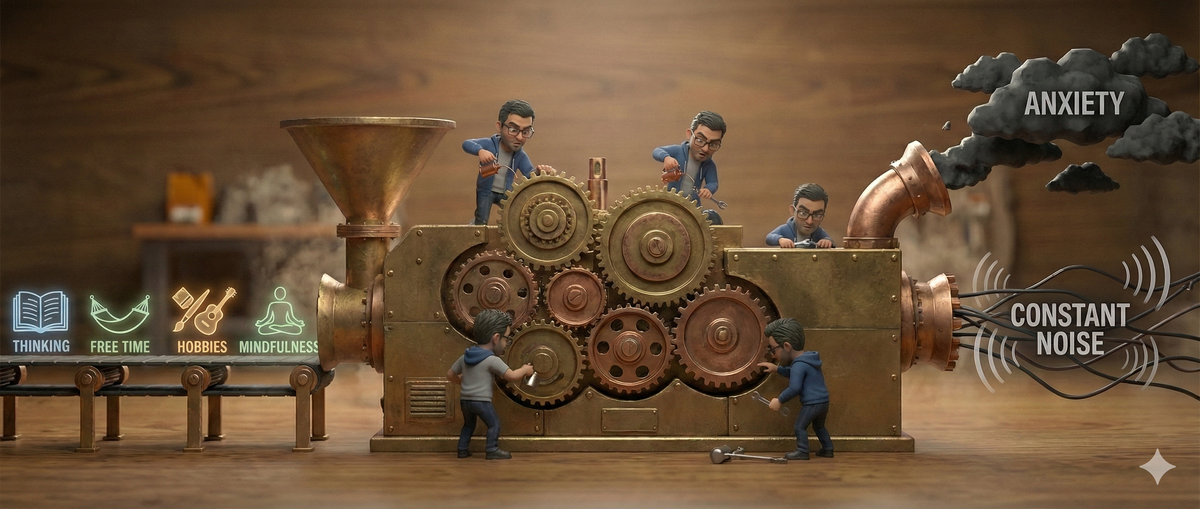
Thursday morning. Headache. The kind that sits behind your eyes and makes every screen too bright. You check your calendar. Two emails need responses. One about business partner coordination. Another about scheduling a customer meeting.
You know you should rest. You took the sick day. But here's the thing: both emails would take five minutes. High ROI, you tell yourself. Small effort, big unblock.
So you write them.
Researchers have a name for this: presenteeism—working while sick in ways that reduce your effectiveness. A Trinity College Dublin study found that working on a day when you're unwell drains mental resources that cannot be recovered overnight. Your performance suffers the next day, not this one.
But I wasn't thinking about tomorrow. I was thinking about now. About keeping things moving. About not being the blocker.
What I didn't see was how this pattern extended far beyond that morning. It shapes how teams operate. And ultimately, the products we ship.
The Culture Behind the Pattern
This isn't a personal quirk. It's systemic.
Organizational psychologists have documented how "hustle culture", the belief that productivity determines worth, systematically undermines both well-being and performance. This isn't just harmful to individuals; it's economically irrational. Researchers studying presenteeism have found that people work through illness primarily to avoid being seen as uncommitted, driven by the fear that rest signals low productivity. The costs compound over time, but we don't see them in the moment.
Somewhere along the way, we absorbed the invisible contract: You are valuable when you are useful. Rest is what you do after you've proven that.
This contract isn't written in any handbook. It's enforced through what gets celebrated: the person who responds to Slack after hours, the team member who never says no, the manager who takes calls on vacation. Through what gets punished: the gap in your response time, the meeting you declined, the boundary you tried to set. Culture doesn't announce itself. It just makes certain choices feel impossible while making others feel inevitable.
These aren't individual choices. They're responses to a pattern we've internalized without questioning it. And once internalized, the pattern scales.
From Personal to Cultural
It doesn't stop at individual choices. It shapes how teams operate.
You schedule back-to-back meetings all day. No breaks. Because breaks feel like wasted time. You celebrate the team member who stayed late to fix the bug. Who worked through the weekend to hit the deadline. Who always says yes to one more thing.
We call this dedication. But we're really rewarding the same pattern: keeping the machinery moving.
And once it's a team norm, it stops feeling like a choice. When everyone around you celebrates heroics over sustainability, when there's no buffer time for thinking or recovery, when "I need a break" sounds like "I'm not committed", the culture makes the decision for you.
This is how individual patterns become organizational ones. Not through policy, but through what gets celebrated. What gets rewarded. What gets called "dedication" instead of what it actually is: choosing the machinery over the mechanics maintaining it.
The Products We Ship
And then there's what we build.
Think about the apps you use daily. Social media platforms. Productivity tools. Communication apps.
Most are optimized the same way: "Just one quick thing." High value, low friction. Small effort, big engagement.
They celebrate metrics like "daily active users" (DAU) and "time in app." They optimize for retention. They A/B test notification timing to maximize click-through rates.
Your fitness app warns that your streak will break if you don't log activity today. Another app will tell you “3 new notifications” as soon as you open it. Yet another networking app will inform you "5 people viewed your profile this week". Your news app sends breaking alerts that rarely break anything. Your shopping app reminds you that items in your cart are "low in stock." Even your meditation app sends you reminders to be mindful.
None of these are designing for peace of mind. They're designing to keep the machinery running.
Researchers at the University of Washington analyzed all Very Large Online Platforms and identified 63 specific "extended-use designs" (EUDs) that fall into four categories: pressuring users with countdown timers and limited offers, enticing them with infinite feeds and autoplay, trapping them with difficult-to-exit flows and modal interruptions, and lulling them by removing all friction to continued use.
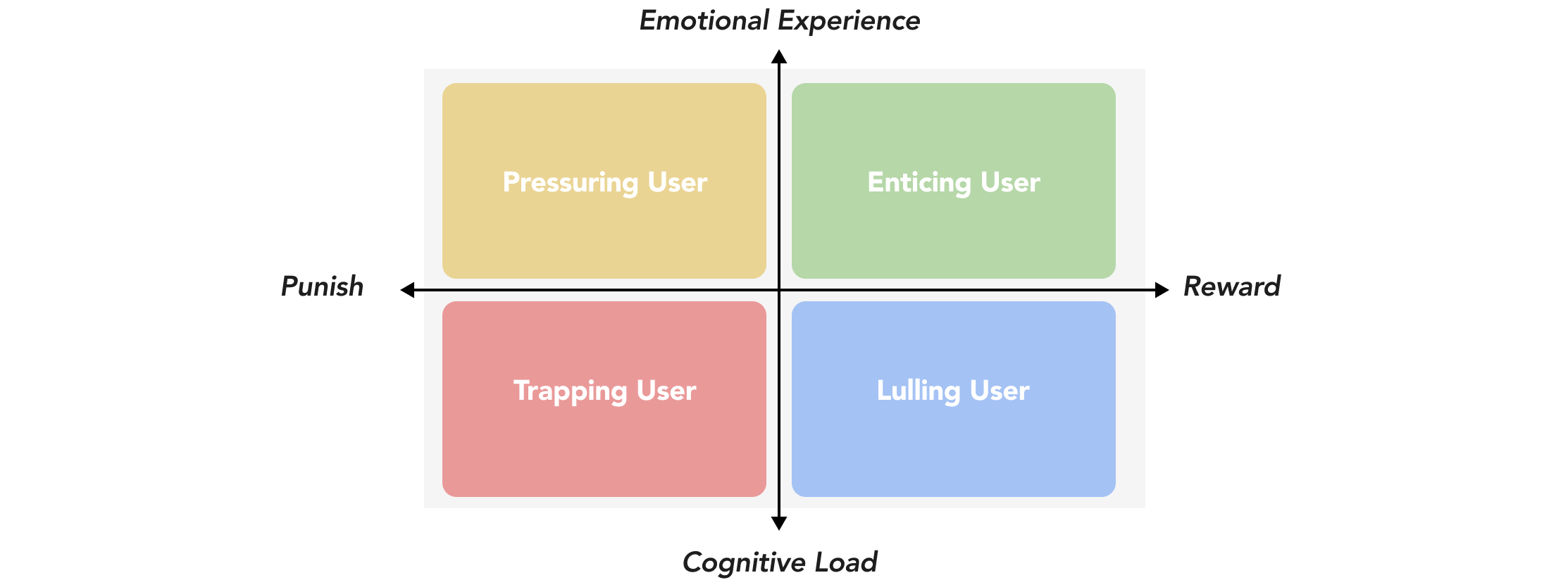
These aren't accidental patterns. They're deliberate choices.
We tell ourselves these metrics are rational. DAU proves product-market fit. Time in app shows value delivered. But like those emails I sent while sick, the justification comes after the decision. The decision, driven by fear of missing growth targets, fear of investors asking hard questions, comes first. The metrics just make the fear feel strategic.
This is Goodhart's Law in action: when engagement becomes the target, it stops measuring what matters. Research shows that optimizing purely for engagement can actually harm retention in the long run and that incorporating non-engagement signals like user well-being can increase it.
You can measure product-market fit without measuring exhaustion. You can optimize for daily value without optimizing for daily anxiety. Customer lifetime value, task completion, and trust metrics predict business success better than time in app ever could.
That notification that says "You have 3 unread updates"? It's a small effort for users. High value for the platform. But the cost, the mental load of always feeling behind, always needing to check isn't measured in the dashboard.
The pattern extends beyond work apps. These products don't just demand attention, they steal the ability to be present without anxiety. The ability to put your phone down and trust you're not missing something important. The ability to rest without wondering what you should be checking.
We build products the way we've been conditioned to work. The same ROI logic. The same fear underneath.
The Business Model Trap
The uncomfortable truth: when advertisers are your customers and users are your product, peace of mind becomes a bug, not a feature.
Research shows that high-quality attention, the kind advertisers actually want, requires only minutes per hour. Premium video content generates 5 minutes of ad attention per hour. Social media platforms? 12 seconds per hour. To deliver the same advertiser value, social media platforms need users to spend 25 times longer. The business model doesn't just encourage distraction, it requires it.
The Pattern Connects
So here's what we've seen: the same machinery runs at every level.
You work through a sick day, telling yourself it's rational, but the justification comes after the fear. Your team celebrates heroics over sustainability but it's choosing the machinery over the mechanics. And products optimize for engagement using deliberate extended-use designs but the business model requires distraction, not peace of mind.
Personal patterns shape team culture. Team culture shapes product decisions. Product decisions shape how millions of people feel when they use technology every day.
The research on presenteeism reveals the core illusion: we believe we're making rational trade-offs between productivity and wellbeing. But the trade-off is false. Working through discomfort doesn't help long-term performance. It delays the inevitable while making the cost higher.
The same is true for teams. And products.
The ROI Illusion
When we send those emails on a sick day, we tell ourselves it's an ROI calculation. Small effort, big impact. Rational trade-off.
But researchers studying presenteeism found something revealing: people consistently report their decisions as rational even when driven by fear of judgment. The ROI logic isn't guiding the decision. It's justifying a choice that fear already made.
This is worth pausing on. Before calculating return-on-investment, what if we examined the decision itself? Not the math we use to defend it, but the sequence of thoughts that led us there.
What usually happens: We feel an impulse (send the email, add the feature, schedule the meeting). Then we feel discomfort about that impulse (is this wise? sustainable? healthy?). Then we reach for ROI thinking, not to decide, but to resolve the discomfort. The calculation makes the choice feel strategic when it was actually reactive.
The pattern becomes invisible because we experience these steps as simultaneous. But they're not. There's a moment between impulse and justification. A space where we could ask different questions.
Not "What's the ROI?" but "What am I responding to right now? What would I do if I didn't need to justify this decision to anyone, including myself?"
Those questions don't lead to easy answers. But they reveal something the ROI calculation obscures: that many decisions we call strategic are actually patterns we've stopped examining.
So what's the alternative?
Peace of Mind as a Design Principle
Here's the question I've been sitting with: what would it mean to design for peace of mind?
Not as a secondary concern. Not as something we add after we've optimized for engagement. But as a primary design principle.
Studies on self-compassion show that treating yourself with warmth and support during stress leads to significantly lower burnout rates.
What if we applied this principle to product design?
Self-compassion in products might look like:
- Default settings that assume users have lives outside your app
- Notification systems designed to reduce anxiety, not create it
- Features with a natural endpoint because infinite engagement isn't a feature, it's a bug we stopped calling by its name
- Metrics that measure "problems solved" not "time spent"
- Interfaces that respect attention as a finite resource
These aren't radical ideas. Organizations like the Center for Humane Technology have already codified principles like these: value human attention as finite rather than extractable, build healthy boundaries with finite feeds instead of infinite scroll, be honest about dark patterns, and design for collective wellbeing rather than individual extraction.
The framework exists. The research backs it. What's missing isn't knowledge, it's permission.
This isn't about building less useful products. It's about asking a different question.
Not: "How do we keep users engaged?"
But: "How do we help users achieve their goals and then get out of the way?"
Some users want notifications. Some want to stay connected. Some benefit from reminders that keep them engaged with communities they care about. That's fine. The question isn't whether engagement features should exist. It's whether users are choosing them based on honest information about the tradeoffs, or whether those features are designed to bypass conscious choice entirely.
The question matters because the problem isn't just individual, it's structural. A PM can ask better questions, but if the business model rewards manipulation, if the incentives flow from advertisers who want maximum attention, if leadership measures success by engagement metrics, individual choices hit systemic walls. Structural problems require structural solutions: changes in business models, regulation, industry standards, and what we collectively decide to value and reward.
The Real Question
When researchers study why people work through illness, they find a consistent pattern: we believe we're helping. We calculate the ROI. We convince ourselves it's strategic.
But the real question isn't "Can I still function?" It's "What am I actually valuing?"
For yourself:
When you work through discomfort, what are you valuing?
The machinery? Or yourself?
For your team:
When you schedule back-to-back meetings with no buffer, what are you valuing?
Efficiency metrics? Or sustainable capacity?
For your product:
When you optimize for daily active users, what are you valuing?
Engagement metrics? Or the humans on the other side of the screen?
Maybe the answer starts with rejecting the premise: that we have to justify our worth through constant productivity. That users have to prove their value through engagement. That rest and peace of mind are rewards for work completed, rather than prerequisites for work that matters.
What if we built products from that principle instead?
Building Differently
I don't have this figured out. I at times fall into old patterns of responsiveness. I shipped features optimized for engagement.
But I'm starting to see the pattern, and seeing it changes the questions I ask:
- Before adding a notification: "Will this give users peace of mind, or take it away?"
- Before normalizing back-to-back schedules: "Are we building sustainability, or burnout?"
- Before measuring success: "Are we tracking outcomes that matter to users, or metrics that matter to us?"
The machinery doesn't care about peace of mind. It runs until it breaks.
But we're not machinery. Teams aren't machinery. Users aren't machinery.
We're humans. All of us.
And maybe the most valuable product we can build is one that reminds people of that.
If you've ever felt guilty for resting or built a product that makes users feel the same way you're not alone. The pattern runs deep. But we can build differently.
Further Reading
Extended-Use Designs on Very Large Online Platforms
Humane Design Guide
Platform Time vs Ads Attention
Optimizing for Engagement Can Be Harmful. There Are Alternatives
What We Know About Using Non-Engagement Signals in Content Ranking
Should I stay or should I go? The role of daily presenteeism as an adaptive response to perform at work despite somatic complaints for employee effectiveness.